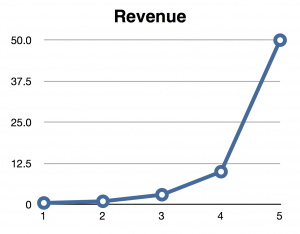
 The substrate of the start up business plan is that the nascent business will reach $50 million revenues per year after 5 years. Venture Capitalists seem to expect that every pitch will have a revenue graph with a hockey-stick shaped revenue line that shows the business at $50M in 5 years. Naturally, this means that constructing a financial model for a startup involves tweaking the spreadsheet to get $50M in 5 years. All of the other predictions of the model are secondary. When have we asked if this is a reasonable goal? Are any Entrepreneurs bold enough to ask VC how many of their portfolio companies have actually his $50M in 5 years? Fortunately, Christian Chalbot of IPO Dashboards has done some analysis to determine how long it takes technology startups to reach $50M. His answer is about 8 years, but that value is determined from studying the top 100 technology companies in the US, ranked by revenue. The number is certainly a gross underestimate, because it doesn’t include any of the companies that did not IPO, failed, or were not in the top 100. In short, even among the most successful US companies, it still takes and average of 8 years to reach $50M in revenue. So, Entrepreneur, next time you are showing your hockey-stick graph, what you are really saying is: “My company will be more successful that Microsoft, Adobe or Novell. " Really, why should anyone believe you? Today, Techcrunch summarizes additional proof that, despite the popular image of the scrappy young entrepreneur, most entrepreneurial activity, and the most successful startups, is run by grey-hairs. This report from the Kaufmann Foundation puts Techcrunch’s hunches to numbers.
Hating The Creators
 In his Labor Day article in Salon.com, Michael Lind satirizes free-market conservatives, who he claims believe that Laborers destroy wealth. In building that thesis, he presents a range of logical fallacies that are interesting to analyze. Mr. Lind doesn’t daly. His opening sentence lays out his theme:
Today is Labor Day, when we celebrate the wealth destroyers – at least if the libertarian right is to be believed.
I’ve never hear such a ridiculous idea — that laborers destroy wealth — expressed by any libertarian, in words nor in print. How did Lind come to think that this idea is typical of the libertarian right? Maybe he is just being dramatic, as his second sentence moderates a bit:
The Perfect Evening
The Perfect 5:00:
 |
The Perfect 5:45:
 |
|---|
Child Sacrifice, For Children Who Love Freedom
Mummification, human vivisection and live burials in a format children can understand. Yes, really. You Wouldn’t Want to Be an Inca Mummy will let parents address most of the uncomfortable questions that don’t involve sex, including human sacrifice, what happens when you yank out someone’s heart, the various ways of clubbing someone to death, and how the commoners should prostrate themselves before their rulers. The authors certainly aren’t operating under a belief in the concept of the Noble Savage. And, it has a cartoonish format and simple text that is suitable for first and second graders. While the book really is disturbing (and disturbing for someone who used to read alt.tasteless on Usenet ), and I’m still not sure when I’d read it with Max, that I’d find this prominently displayed on the “New Books” shelf in the children’s section of the library absolutely thrills me. When the media seems to be failing in its critical role as defenders of open, free expression, we still have librarians who will fight to put whatever they damn well want to on the shelves. Here is another example. F’d Companies is the most profane, nearly obscene, book I’d ever admit to reading, but it is also an important chronicle of the insanity of the late 1990’s. I nearly howled with joy when I saw it on a public library shelf. I could imagine the librarian placing it facing outward, thinking to herself that it would be a poke in the eye of every sanctimonious prude that passed by. God bless her.  Don’t forget, kids, child sacrifice is a privilege.

Dispatch from the Battle of the Sexes
Yes, we play golf to get away from you:
Secret #2: We actually do play golf to get away from you More than 21 million American men play at least one round of golf a year; of those, an astounding 75 percent regularly shoot worse than 90 strokes a round. In other words, they stink. The point is this: “Going golfing” is not really about golf. It’s about you, the house, the kids – and the absence thereof. “I certainly don’t play because I find it relaxing and enjoyable,” admits Roland Buckingham, 32, of Lewes, Delaware, whose usual golf score of 105 is a far-from-soothing figure. “As a matter of fact, sometimes by the fourth hole I wish I were back at the house with the kids screaming. But any time I leave the house and don’t invite my wife or kids – whether it’s for golf or bowling or picking up roadkill – I’m just getting away.”
Life Before Child
 Although I’d never go back, there are a lot of things I did before children ( the boy and the business ) that I don’t do much anymore, like hiking. Here is a link to Gary Stowell’s website detailing a hike to Carrizo gorge in 1999.
I Used To Be Famous For Slipperyons
Before child, I hosted an annual iceblocking party at Kate Sessions park. Here is a video from James Hicks, where I explain the physical theory.
Geeky Calling Cards
I created a new personal calling card, and decided to emphasize"Geek": 

A Post-4th Celebration of Capitalism

School Boards Influence Economics Texts
Authors of economics textbooks for high school students are virtually required by school boards to discount free markets and promote state intervention. That’s the conclusion of a Mackinac center report, which includes direct statements to that effect from the textbook authors themselves. Here are some quotes from economics textbook authors:
“I agree with your review of my economics textbook. In fact, I have in the past made suggestions to the publisher for changes along the lines of that in your review. The problem is that I’m not in control of what is going into the text. The publisher dictates the final result of what will be in the text. The publisher has full and complete veto power over the contents of our text. And the publisher wants a more liberal view presented in the text, and so that is what is in there. They especially want government intervention treated with favor in several chapters of the text.”