Compensatory Education

After reading Charles Murray’s skepticism regarding a study of the Harlem Children Zone, I did a quick search for research about some of the programs he mentions in the article. These are some of the best known programs that attempted to improve the test scores and social skills of poor an under-preforming students:

  • Harlem Children’s Zone
  • Milwaukee Project
  • Abecedarian Project
  • Perry Preschool

The most complete summaries of these programs, including extensive bibliographies, come from the Coalition for Evidence-Based Policy, such as:

Continue Reading →

Economic Sophistries

Eliot Spitzer has written a provocative article for Slate addressing the idea that high marginal tax rates reduce GDP. From the first two words — the title, Tax Fraud — we know how Spitzer feels about common arguments against higher or more progressive taxes. He writes:

The result of sky-high marginal rates, this anecdote was supposed to prove, was declining productivity and economic growth. Is this true? Let’s look at a graph of the nominal top marginal tax rate in any given year and GDP growth in that year.

Continue Reading →

SoCal Surf Towns Ranked

Here is a list of the top surf towns in Southern California. The list is computed by taking the number of web searches for the area name plus “surf shop” and dividing by the population of the area. All percentages are expressed relative to the top result. The area names come from Zillow.com, and are the named areas that are on the coast or adjacent to an area on the coast. We only considered areas between Tijuana and Santa Barbara. Del Mar100.00%
Malibu97.73%
Ocean Beach53.04%
Mission Beach34.70%
Venice25.91%
Laguna Beach22.73%
Dana Point20.39%
Solana Beach18.25%
Pacific Beach18.21%
Hermosa Beach18.15%
Santa Monica18.09%
La Jolla17.61%
Encinitas16.01%
San Clemente15.97%
Manhattan Beach12.97%
Santa Barbara12.36%
Ventura11.81%
Huntington Beach11.09%
Newport Beach9.45%
Coronado8.64%
Carpinteria8.04%
Seal Beach7.54%
Long Beach5.07%
Oceanside4.83%
Carlsbad4.55%
Imperial Beach4.46%
San Diego3.72%
Redondo Beach3.43%
Orange2.34%
San Pedro1.95%
Vista1.54%
Costa Mesa0.62%
Oxnard0.31%
Continue Reading →

Do Progressives Eat Awareness?

While updating my iPhone I found a peculiar application, Stand Up Take Action, which allows people to click a button and get counted to express their support for the United Nations Millennium Development Goals. The application didn’t have any other purpose, like asking you to make a donation. So I went to their website, which is entirely oriented around holding events where people literally stand up and get counted, and the count of participants is sent to SUTA headquarters. Where in this process of raising awareness does a hungry or oppressed person get food or freedom? How does skipping a meal give food to the poor? Do the organizers think that the Third World can be lifted out of poverty with good thoughts? If these events result in nothing more than people spending an hour chanting and feeling good about themselves, they are worse than useless, because the participants have done nothing but express their expectation that someone else solve the problem. When I am concerned about poverty I write a check to Heifer International, because people can eat cows, but they can’t eat awareness. If you actually care about poverty, skip the awareness building, accept that you can do something about the problem, and donate you money or time. If you do go to an awareness event, bring your checkbook and demand that your friends do the same.

Continue Reading →

Does Concealed Carry Permitting Trigger Bloodbaths?

government-blank-pistolA common argument against concealed carry weapons permits (CCW) is that it would result in more crime, often expressed hyperbolically as precursor to a bloodbath. With 48 states allowing some form of concealed carry, we should expect that there have been enough natural experiments to answer this assertion definitively. My expectation is that the people who are likely to request a CCW are not likely to commit crimes. Criminals would carry regardless of a CCW permit, so allowing concealed carry in a state should not increase the number of criminals that have firearms. Florida has issued over 1.6 million CCW permits since 1987 and only 167 have been revoked because the permit holder committed a crime with a firearm. That implies that only 0.01% of CCW permit holders commit firearm-related crimes. Florida revoked 0.3% for all reasons combined. North Carolina reports 0.2% revocations for any reason. Since most permit holders are male (85%) , and most crimes are committed by males (91% for weapons crimes), we can compare the revocation rates to male crime rates. There are about 300,000 assaults and robberies per year committed with firearms, and about 150M men, a whole-population rate of commission of firearm-related crimes of 0.2%. This suggests that CCW permit holders commit firearm related crime at a rate of about 1/20th of the rate of the general population. You should actually feel safer among CCW holders than the average population.
Continue Reading →

Why We Are Worried About Debt?

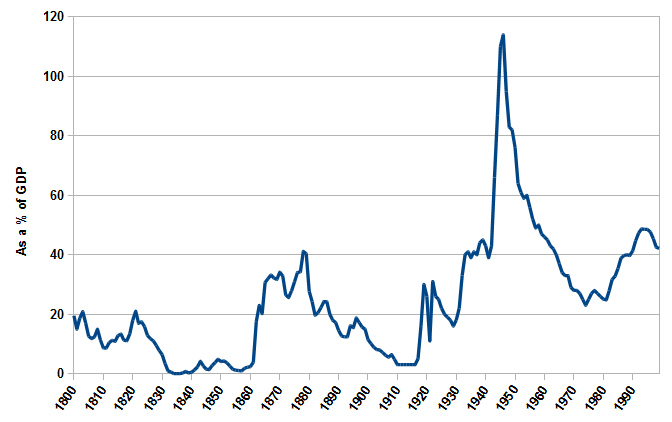
Robert Reich recently posted an article on Salon about why we should not worry about the US government debt, and why it should be even higher that it is now. Government spending, he says, got us out of the Great Depression, and it can get us out of the current recession. Reich’s dad though that it would take 60 years to pay of Roosevelt’s debt, and it only took 20, so why are we worried now? Here is a graph that illustrates Mr. Reich’s point: US_Federal_Debt As Reich claims, the debt was higher in the 40’s, as a percentage of GDP, and it was paid off ( to a pre-war level ) in about 20 years. I’m still worried. We don’t know what the next 20 years will bring. If those years are as prosperous as 1945 to 1965, a larger debt, and associated spending, may be a net benefit to our economy, but there is a deeper problem. Here is a graph from the GAO report A Citizen’s Guide to the 2008 Financial Report of the U.S. Government that shows the sum of the US Government’s expenses, from 1970 to 2080:

Continue Reading →

Trying Out Google and Facebook Friend Connect

Would you be my Friend? Here is Google’s Friend Connect Widget:

var skin = {}; skin[‘BORDER_COLOR’] = ‘#cccccc’; skin[‘ENDCAP_BG_COLOR’] = ‘#e0ecff’; skin[‘ENDCAP_TEXT_COLOR’] = ‘#333333’; skin[‘ENDCAP_LINK_COLOR’] = ‘#0000cc’; skin[‘ALTERNATE_BG_COLOR’] = ‘#ffffff’; skin[‘CONTENT_BG_COLOR’] = ‘#ffffff’; skin[‘CONTENT_LINK_COLOR’] = ‘#0000cc’; skin[‘CONTENT_TEXT_COLOR’] = ‘#333333’; skin[‘CONTENT_SECONDARY_LINK_COLOR’] = ‘#7777cc’; skin[‘CONTENT_SECONDARY_TEXT_COLOR’] = ‘#666666’; skin[‘CONTENT_HEADLINE_COLOR’] = ‘#333333’; skin[‘NUMBER_ROWS’] = ‘5’; google.friendconnect.container.setParentUrl(’/’ /* location of rpc_relay.html and canvas.html */); google.friendconnect.container.renderMembersGadget( { id: ‘div-4019134814077193782’, site: ‘18179748395891449876’ }, skin); And Here is Facebook’s. Facebook requires a lot more work, because you have to program in XFBML Your picture, if you are logged into facebook: Here are a bunch of your friends:

Continue Reading →

Cheaper Recyclables Collections

Interested in doing a science project, Max and I went to the alley to collect a 2 liter plastic bottle from the recyclables bin. I had put the bottle in the bin the day before but could not find it that day. I also noticed the beer and wine bottles were missing, but the paper and cardboard were still there. The common factor in the missing items was the California Redemption Value tax, and the next day the mystery was completely solved, when I saw two people in the alley collecting bottles from the bins. The California Redemption Value (CRV) like other deposit charges, and the Oregon Bottle Bill that preceded it, were largely intended to decrease roadside trash and increase recycling rates. They are very effective because of the economic principle that people respond to incentives. If there is enough of a benefit to either not throwing a bottle away, or picking it up after it has been discarded, the bottle will not end up in the trash or the roadside. The same thing happens on the beach, where bathers will intentionally leave aluminum cans behind because they know someone will pick them up. These deposit charges are a classic market solution, and are an excellent way for the government to shape society. Rather than trying to jail or fine people who litter, governments can use financial incentives to encourage the desired behavior. This mechanism is also know as “internalizing negative externalities” or a Pigovian Tax. The incentive works, and it works very well. I doubt that the recycling collection on my street gets anything except paper. I’d expect that this effect results in the recycling program being lees financially viable, since people are removing the most valuable recyclables from the program and claiming the CRV and recycling value for themselves. We could get upset about this, and make trash picking illegal, or we could use the effect to make recycling programs more effective. One possible improvement would be to add a redemption value for all recyclables and replace recycling bins with low, wide bins that make it easier for trash pickers to remove items, which would allow governments to eliminate collection of recyclables. This scheme would require adding the CRV to all recyclable containers, which would raise the price of many products, making it politically unpopular, and many progressives would oppose the plan because it encourages the poor to take on a low wage job. But despite these hurdles, employing incentives is one of the most powerful ways for governments to encourage socially valuable behavior.

Continue Reading →

The Evil of Denying Claims

deny_full A common argument against the current state of American health care is that the evil insurance companies make their obscene profits by denying claims. I don’t intend to tackle the question of the moral right of companies to make profits, or to defend the current state of American health care, but I do want to address the moral and economic issues of health care companies denying claims. One of the important implications of the law of supply and demand is that when the price of something drops, demand increases, and if the price is zero, people will probably demand more than there is supply of the thing. If the thing is plentiful, like air, there isn’t much problem. For for everything else, a price of zero usually means lines, shortages or rationing. Imagine anytime a company like Starbucks or McDonalds gives it’s products away: the offer generates a crowd, and all the free stuff is gone before you get there, so you don’t get any. A second important economic principle is that “people think on the margins.” This means that most economic decisions are based on the price of one more thing, not the price of the things you already have. If you have already had an ice cream cone, you probably won’t want to pay $2 for another one. But if the price is free, you will probably take it. You decision is based on the fact that the next cone is free, not that the average price for both cones is $1. When most people get health insurance, they pay a fixed price up front, or have their employers pay that cost, and the cost of any of the procedures after that is small. The real cost of going to the doctor one more time may be $200 per visit, but with health insurance, that marginal cost is $20. The same thing is true for most other procedures. This means that regardless of what the average cost of a procedure is to a person, the marginal cost is very low relative to the actual cost. So, we have a low marginal cost, and that means that people are going to demand more of it. If going to the doctor for a cold cost me $200, I would only go if I am really sick. But for $20, I’ll go just to find out what I’ve got. Thus the low marginal cost results in a higher demand. Since people naturally want to stay healthy, they will demand to get more health care than they have actually paid for. Since the health care company cannot rely on price to regulate demand, they have to rely on an administrative procedure, which takes the form of denying claims. If they didn’t deny any claims, everyone would spend more than they paid, and the insurance company have cost overruns, possibly going broke. The NHS may already be in this situation. That’s not a criticism of the NHS, just a sign of the natural desire for everyone to get more (service) and pay less (taxes). If the US had a single-payer system like the NHS, the marginal cost of health care would drop even more; it would be marginally free to everyone, so the demand would increase even more. A single payer health care system would have to deny even more claims than the system we have now. That alternate system could be an improvement over the system we have now, but we should expect that the number of claims it will have to deny would actually increase. So, the general act of denying claims is not an evil; it is a necessary component of any system where the marginal cost of care is less than the actual cost. What is evil is when a health care provider denies a claim that they have agreed to pay as part of the contract with the insured. This case, however is a matter of contract law, and if it were widespread, it would be handled very effectively through class-action lawsuits. ( Image from Solid Threads. Please visit them so they don’t sue me for stealing their image. )
Continue Reading →

Daily Mail Sucked In By Science Hoax

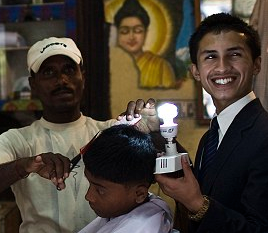
HairCellThere is always someone who will believe an incredible science or technology story, especially when the technology could save the planet, or is invented by a teen-ager, or comes from the third world. When the story has all three elements, the suckers get in line. Today, the Daily Mail reports that an Indian teen-ager has created an inexpensive solar cell from human hair. It is an inspiring story about a plucky teen who will one day change the world. The only way for it to be a better story would be for it to be true. I’d be happy if it just were not jibberish. As with many hoaxes, there is an element of truth. Melanin, a component of dark human hair, is a semiconductor and is photo-reactive, and you can use it to create a solar cell. However, these cells, like most solar cells made from organic semiconductors, are not very efficient, about 2.7%. Unless the cell is virtually free, 2.7% is not going to change the world. So, it is possible to do, and it has been know to be possible for about 40 years, but it isn’t economically feasible. Also, it isn’t very easy to do. You have to extract the melanin from the hair (pdf) into a solution or a substrate, and one of the electrodes is copper wire coated with silicon. What is certain not to work is to string the hair along thumbtacks on a board, which is what it appears the intrepid teenager did. The probable problems with this arrangement are numerous:

Continue Reading →