I have an old garage, built in 1942. It is built on a weak concrete pad, which is thoroughly cracked and some of the walls have settled, along with parts of the pad, by almost an inch. I’d like to build a new roof with a sturdier loft space, possibly a full-height second floor, but I can’t put anything new on top of the existing walls, and I really don’t want to raze the building. Additionally, the building has about a 1 foot setback, which I’d like to keep.
Summer Robot Program

In the summer, I run a program for High School and College students to learn about building and programming robots. The main robot we are working on is a small 6-axis lab robot, which was built in 1994. We completely replaced all of the power supply, controller hardware and software.
The program is very flexible, with all dates, times and tasks customized to the availability and interests of each student. Students will meet with me, in my home workshop in Pacific Beach, San Diego, 1 to three days per week for up to 12 weeks.
Where is Zero?
One of the peculiar things about New York City is how tall the hotdog stands are. They are nearly as tall as the Empire State Building! They really are; the top of a New York hot dog stand and the Empire State Building are both about 6,357,000 meters above the center of the Earth.
There are a lot of things that can be distinguishable, or not, depending on where we put the zero. If the zero point is at the center of the earth, you can’t tell a hot dog stand from a skyscraper, but if you put the zero at ground level, you can. This same principle applies to a lot of things such as the distinguishability of males and females, the importance of humans being 98% genetically similar to chimpanzees, or anything related to racial differences. If we analyze the totality of the personalities of males and females, we are all nearly identical, but if we ignore all of the common elements of our humanity, men and women are very different.
Love and Data
Heart vs Head is an ancient debate, but for most important decisions, we need to use both. For public policy, I think the optimum combination is data and love.
By love, I mean the more sophisticated religious formulations, with many different kinds of love. Love you neighbor, but also love your enemy. Parental love and brotherly love which are often stern, not nice, friendly, or agreeable.
To best use data in making policy decisions, you have to really care about people, but also have enough courage to be willing make people angry. Loving decisions are not always popular. Teens never praise their parents for grounding them.
The Gun Conversation We Should Be Having
Predictably, yet another mass shooting has led to yet another impassioned debate about the AR-15. And predictably, this debate will result in no useful outcome, because it is not the discussion we should be having. Instead of debating the AR-15, we should be talking about ammo and politics.
As many gun owners explain in every round of this debate, the AR-15 is just a semiautomatic rifle with some military-style cosmetics. Almost none of the features that gun control advocates get agitated about affect the lethality of the weapon, and they rarely talk about the things that do: muzzle energy, supersonic velocity, and muzzle power. We should be regulating these factors, not how the gun looks.
What Happened in Baltimore in 2015?
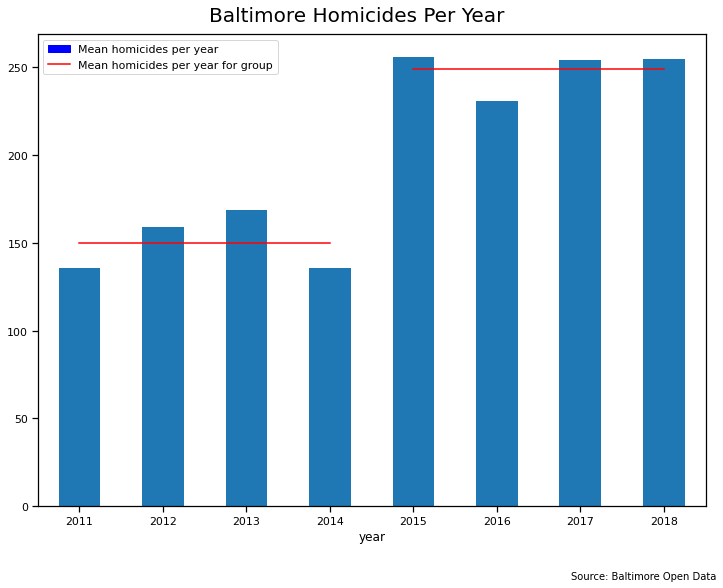
What might have caused the mysterious break in homicides rates in Baltimore in 2015?
The annual number of homicides in Baltimore shows a very dramatic break from 2014 to 2015. In the 4 years before 2015, homicides averaged about 150 per year, but in 2015 an later, about 250 per year, a jump of 60%.

Looking within the years 2014 and 2015, we can see when the divergence started. There is a lot of noise in homicide time series, but the big break seems to happen about week 16 or 17 in 2015, the weeks of 19 April through 2 May. There are a lot of possible causes for increases in homicides, but there is one notable event that happened about that time: Freddie Gray was arrested on 12 April 2015, and died on 19 April 2015.
Yes, Private Companies Can be Subject to The First Amendment
In the last few years, a lot of people who previously would have hated Libertarian ideas — such as the idea that private organizations should be relatively free from government interference — are now quite happy with them, at least the ones that now allow their team to restrict the free expression of the opposite team.
Most often, this takes the form of an argument that private companies are not subject to the First Amendment. The counter argument is that our country is worse off regardless of who is censoring speech, and even if private interests can curtail speech they don’t like, they shouldn’t.
However, the Supreme Court has often ruled that not only shouldn’t they, they can’t.
Beyond the True Believer
Mass movements, and cultural changes in general, are driven by True Believers, people who are committed to their cause with religious zeal. But the core of the movement is often too small to make much progress without mobilizing others. Beyond that core of True Believers, I think, is a much larger group of people who are self-interested and will follow along with the True Believers, not because they believe as the zealots do, but because they see advantages in doing so.
The Next Frontier of Open Data
“But in January, Busboom founded the San Diego Regional Data Library, to “make our social programs, civic groups, and government organizations more effective; our citizens better informed; and our policy makers able to make better decisions,” according to the library’s website.”
Let’s create the Americorps for data in San Diego.
A lot of the issues we have now are so fine-grain that you have to have good data to [solve them],” Busboom says. “Our nonprofits and governments often don’t have access to the skills that are required to do that. The goal is to find volunteers and make connections.”